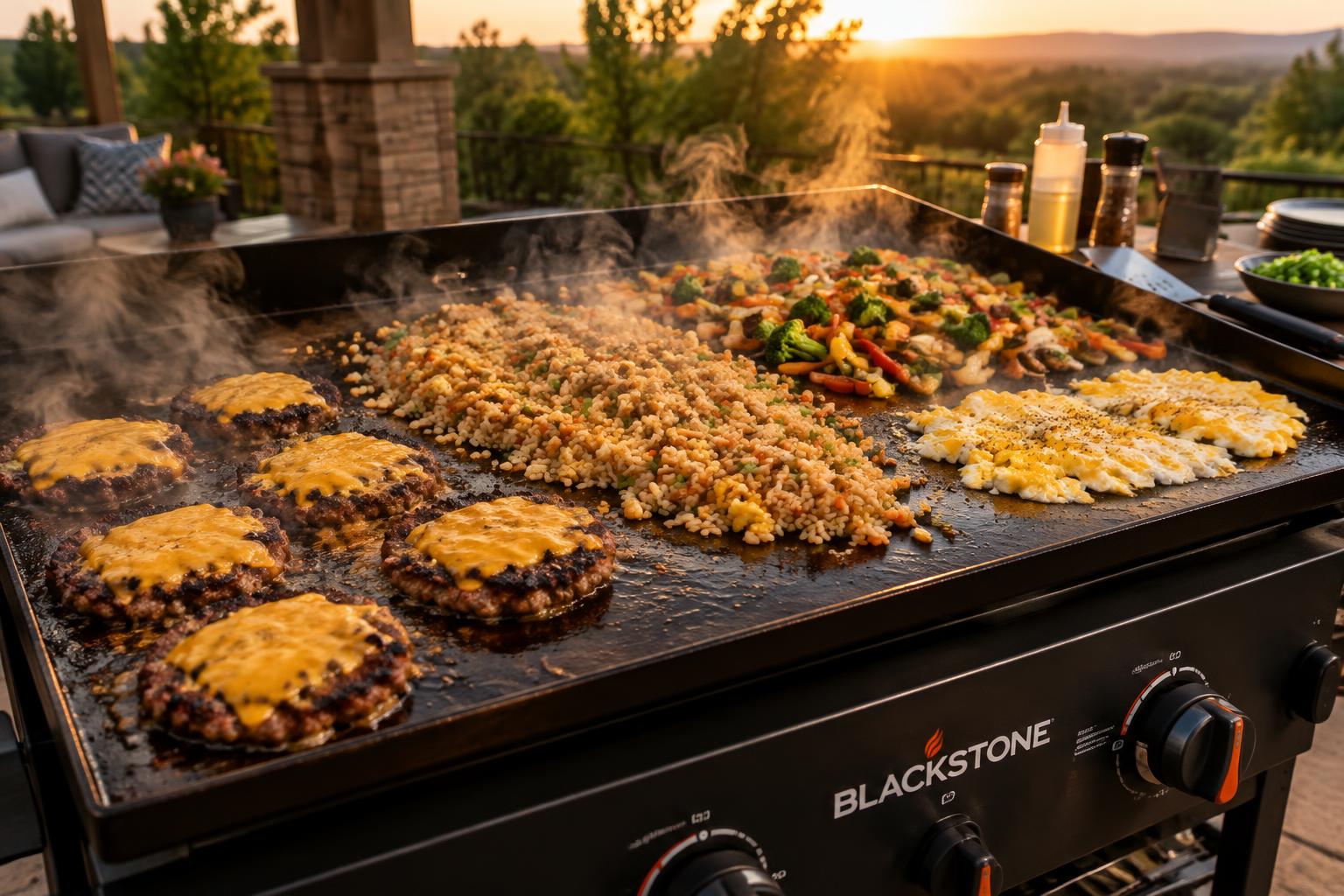
A large griddle like a Blackstone is a whole kitchen in one surface. Set up heat zones, start the slowest foods first, and move food — not the knobs — and breakfast, lunch or dinner for a crowd finishes hot at the same time.
Part 01
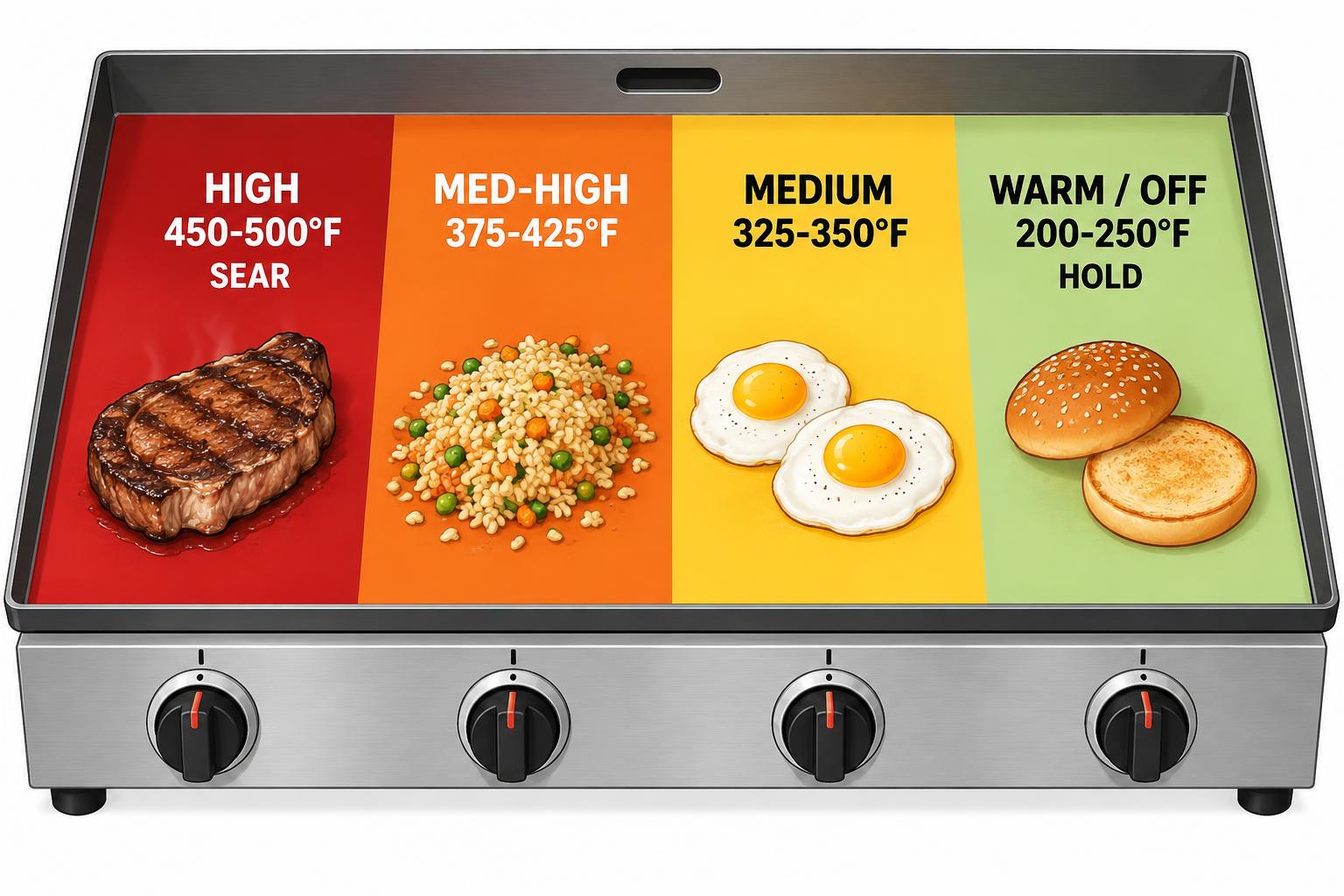
Start here: the heat-zone diagram
Each burner heats a band of the cook top. Set them in steps from hot to warm and you have four cooking surfaces at once. This layout is the starting point for every meal in this lesson.
Use one burner high and one low. The front edge and corners run cooler — use them as your holding zone.
Part 02
The tools of a flat-top cook
Two long spatulas and a scraper
Your hands on a flat-top
Two wide metal spatulas move, chop, toss and flip — fried rice and hash are made by working them together. A flat scraper clears the cook top between foods and at the end. A burger press makes smash burgers, and a melting dome (basting cover) traps steam to melt cheese, cook eggs and pop corn.
Squeeze bottles, thermometer, sheet pans
Set up before the burners go on
One bottle of oil, one of water (for steam and cleaning). An infrared surface thermometer tells you each zone's real heat; an instant-read probe tells you when meat is done. Keep sheet pans for raw food in, and a clean pan for cooked food out.
Part 03
The basics: season, heat, cook, clean
1
Season it like cast iron
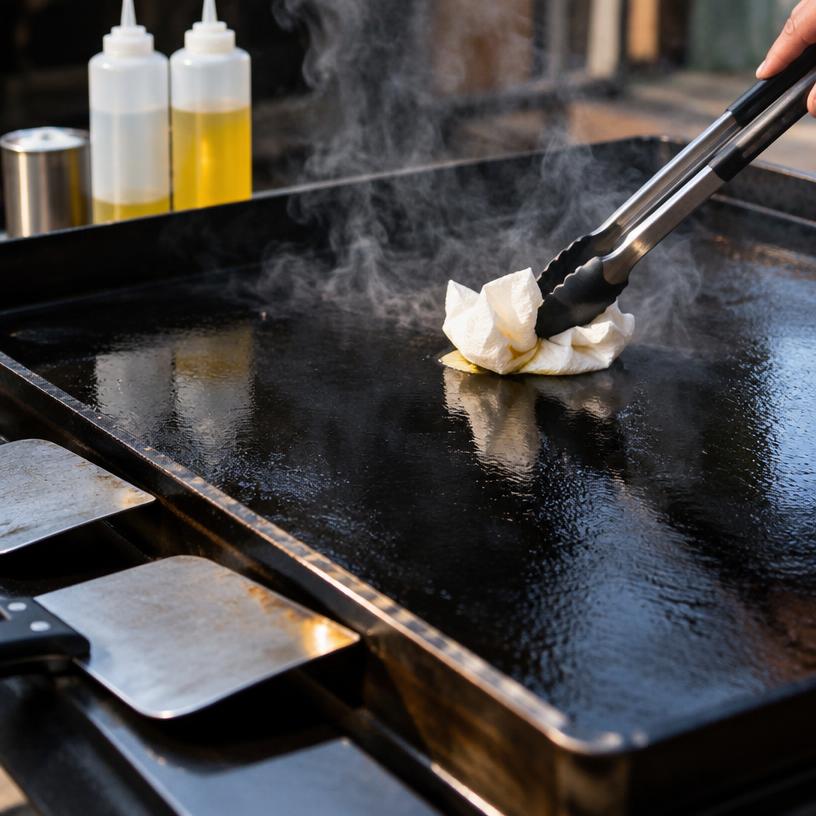
A new or bare griddle top gets 3–5 thin coats of high-smoke-point oil: heat on high, wipe a paper-thin layer with paper towels held in tongs, let it smoke off until it stops (15–20 minutes), repeat. The top turns black and slick — that's your nonstick surface.
2
Preheat 10–15 minutes
All burners on high for about 10 minutes, then turn each knob to its zone setting and give it 5 more minutes to settle. Water drops that skate and dance mean the surface is ready.
3
Set your zones left to right
Use the diagram: hottest on one side stepping down to warm on the other. Check each band with the infrared thermometer — the center often runs hotter, the edges and corners cooler.
4
Plan the order: longest first
Work backwards from serving time. Potatoes and raw meats go on first, vegetables next, eggs and quick foods last, buns and tortillas in the final minute. Everything finishes together in the warm zone.
5
Oil lightly, only where you cook
A small squeeze — about a teaspoon — right where the food will go. A seasoned griddle needs very little. Spread it with the spatula.
6
Move food, not knobs
When something is browning too fast, slide it one zone cooler instead of fiddling with burners. Too slow? Slide it hotter. This is the core griddle skill.
7
Scrape between foods
Push crumbs and grease into the rear or side grease trap after each batch, so fish doesn't taste like onions and pancakes don't pick up burnt bits.
8
Clean and oil while warm
Scrape everything off, squirt water on the hot surface to steam off stuck bits, scrape again, wipe dry, then wipe on a thin coat of oil. Cover once cool. Never use soap on the top.
Part 04
Cooking many items at the same time
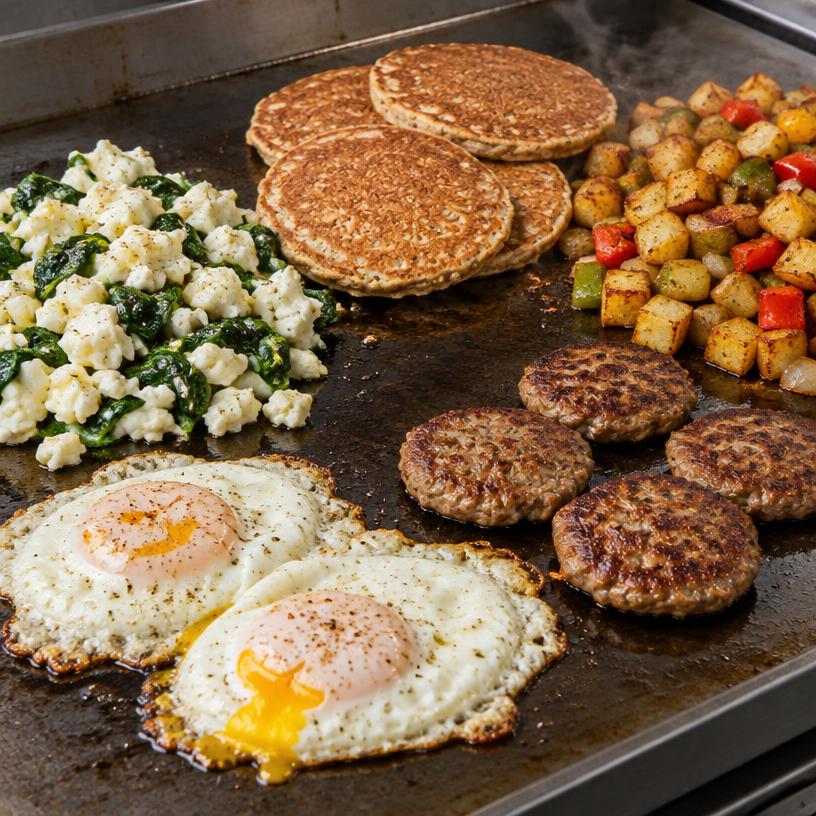
Here's a real 20-minute breakfast for four, step by step. The same idea works for any meal: longest-cooking foods first, quickest last, and the warm zone holds everything until it's all ready.
0:00
Diced potatoes and onions on Zone 2 with a little oil. Turkey sausage patties on Zone 2 beside them.
0:08
Flip sausage; toss potatoes. Start peppers and spinach on Zone 2's edge.
0:12
Pancake batter on Zone 3 in neat rows. Sausage (165°F) slides to Zone 4 to hold.
0:15
Flip pancakes when edges look dry and bubbles pop. Crack eggs onto Zone 3; dome them with a splash of water for steam-set tops.
0:18
Pancakes and potatoes slide to Zone 4. Toast whole-wheat English muffins on Zone 4.
0:20
Everything plates hot at once. Scrape the top and squirt water to clean.
Part 05
From breakfast to seared mahi, pizza and popcorn
1
Beginner
Big griddle breakfast
Zones 2–4 • medium-high to warm
Works well with: Eggs, egg-white scrambles, whole-wheat pancakes, turkey sausage, breakfast potatoes
Start potatoes (par-cooked dice work best) and sausage on Zone 2 first — they take longest.
Pour pancakes on Zone 3 (325–350°F). Flip once when bubbles pop and edges set, about 2 minutes a side.
Eggs on Zone 3 in a little oil. For over-easy, flip gently; for sunny tops, squirt water beside them and cover with the dome 1 minute.
Hold finished items on Zone 4 until everything is ready.
Golden pancakes, crisp potatoes, sausage at 165°F, egg whites fully set — all ready at the same moment.
2
Beginner
Smash burgers and lunch
Zone 1 high • Zone 4 for buns
Works well with: 93% lean beef or turkey smash burgers, chicken sandwiches, quesadillas, Philly-style chicken
Roll lean ground meat into 3-oz balls. Zone 1 must be 450°F+.
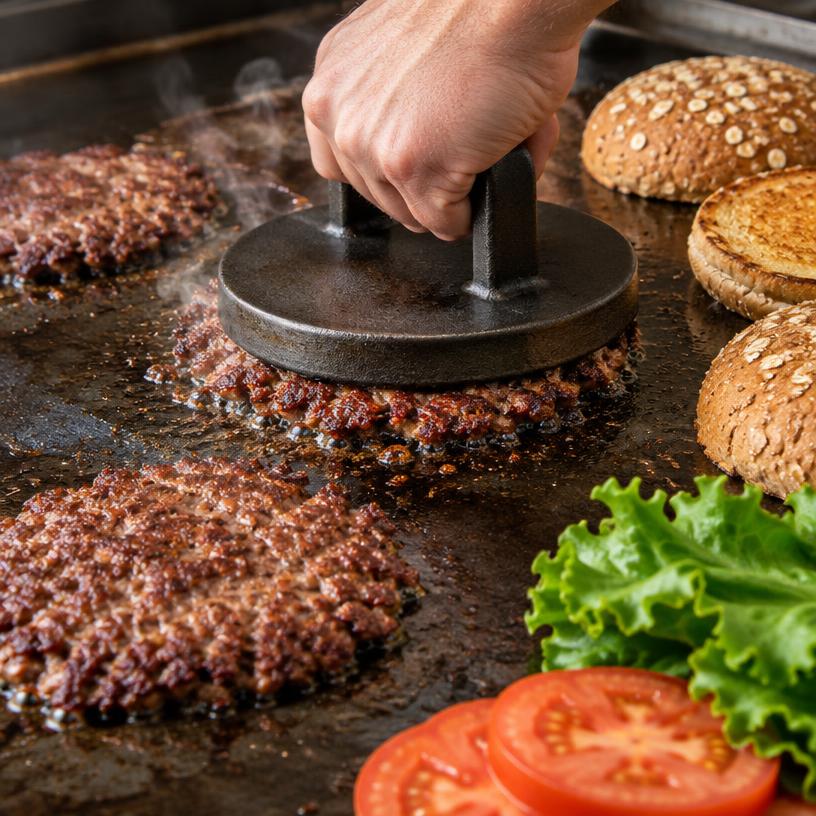
Place a ball down, cover with parchment, and press hard with the burger press within the first 30 seconds. Season the top.
Cook 2 minutes until the edges are deep brown and lacy, scrape under it with a sharp spatula and flip. 1 more minute; add cheese and dome 20 seconds if using.
Toast whole-wheat buns cut-side down on Zone 4 while the burgers finish.
Crisp brown crust on a thin patty. For ground beef, cook to 160°F. For ground turkey, cook to 165°F. Verify the temperature with a food thermometer — color alone is not a safe test. Press only once — pressing after the flip squeezes out juice.
3
Intermediate
Seared mahi-mahi
Zone 1 high, then Zone 2
Works well with: Mahi-mahi, salmon, cod, scallops, shrimp
Pat 1-inch fillets very dry and season with pepper, paprika, garlic and lemon zest. Light oil on the fish, not just the griddle.
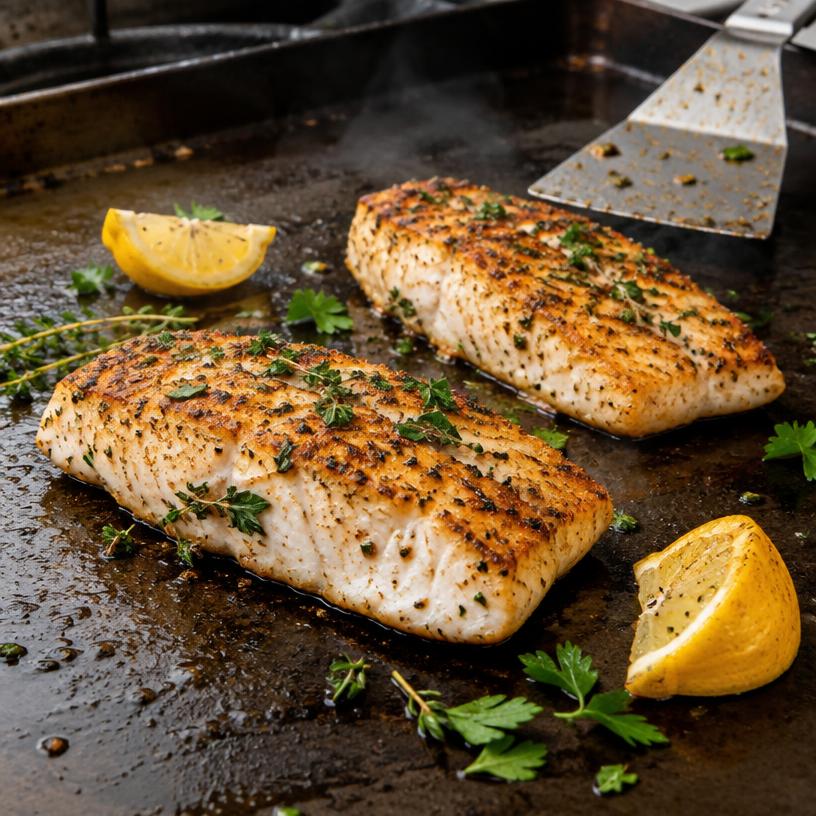
Lay on Zone 1 (450°F) and leave it alone 3–4 minutes until a golden crust forms and the fish releases on its own.
Flip with a thin wide spatula and slide to Zone 2. Cook 2–3 minutes more.
Finish with lemon and fresh herbs. Shrimp take 1–2 minutes a side on Zone 2.
145°F inside, opaque and just flaking. If it sticks when you try to flip, it isn't ready — wait 30 seconds more.
4
Intermediate
Hibachi fried rice
Zone 1 and Zone 2 • high, fast
Works well with: Day-old brown rice, eggs, chicken or shrimp, peas, carrots, onion, green onion
Use cold, day-old rice — fresh rice turns mushy. Prep everything first; this moves fast.
Cook diced chicken on Zone 2 until 165°F; hold on Zone 4. Sauté onion, carrots and peas on Zone 2.
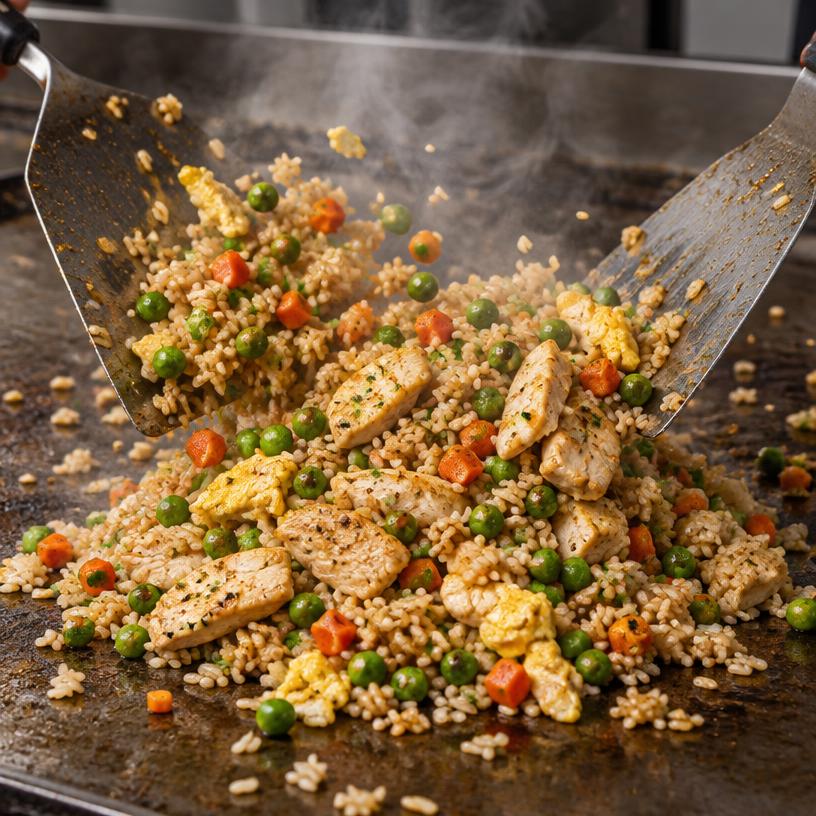
Spread rice thin on Zone 1 with a little oil and let it toast 1–2 minutes without moving. Scramble eggs beside it on Zone 2.
Chop everything together with two spatulas, add a small splash of low-sodium soy sauce, sesame oil and green onion, and toss 1 minute.
Rice grains separate and lightly crisp, not wet. Use half the soy sauce you think — garlic, ginger and rice vinegar add flavor without sodium.
5
Intermediate
Fajitas and dinner for a crowd
Zone 1 for peppers • Zone 2 for chicken
Works well with: Chicken or flank steak fajitas, Philly-style plates, stir-fry, teriyaki vegetables
Slice chicken or steak into thin strips and toss with lime, garlic, cumin and chili powder.
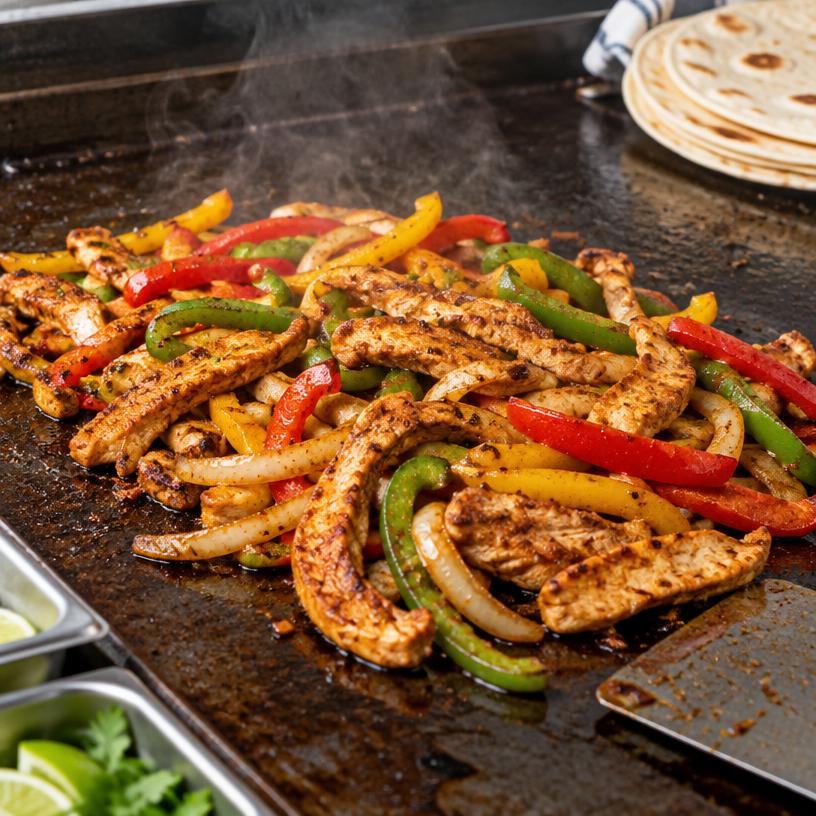
Peppers and onions on Zone 1 to blister and soften, 6–8 minutes, tossing often.
Meat on Zone 2 in a single layer — crowding causes steaming. Toss after 2 minutes; cook chicken to 165°F / 74°C, and steak to 145°F / 63°C followed by a 3-minute rest.
Combine in the center, squeeze lime, and warm tortillas on Zone 4 for 20 seconds a side.
Charred edges on the peppers, browned meat, no pooling liquid. A big griddle can feed eight at once with this layout.
6
Advanced
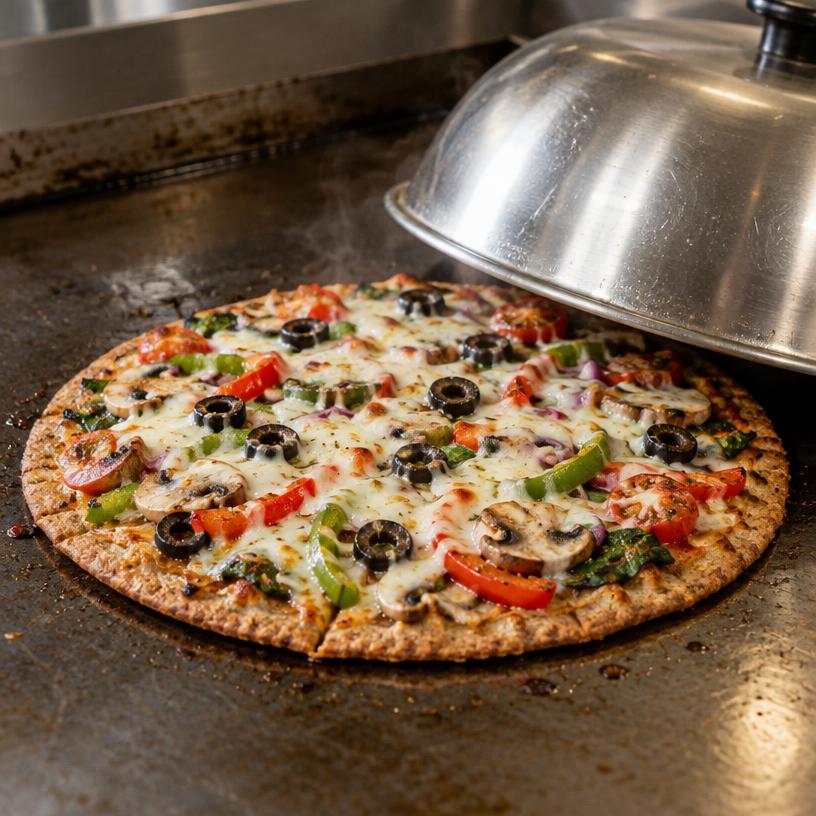
Griddle pizza
Zone 2 then Zone 3 • under a dome
Works well with: Thin whole-wheat crust, flatbreads, naan pizza, tortilla pizza
Stretch thin dough and par-cook it on Zone 2 for 1–2 minutes until the bottom has spots and bubbles form. Flip.
Move to Zone 3. Quickly add sauce, a light layer of fresh mozzarella and pre-cooked vegetables on the browned side.
Cover with the dome and squirt a little water around the edge (not under the crust) to steam-melt the top, 2–4 minutes.
Check the bottom often; slide to Zone 4 if it browns before the cheese melts.
Crisp, spotted bottom and bubbling cheese. Thin is key — thick dough burns outside before it cooks through on a flat-top.
7
Fun bonus
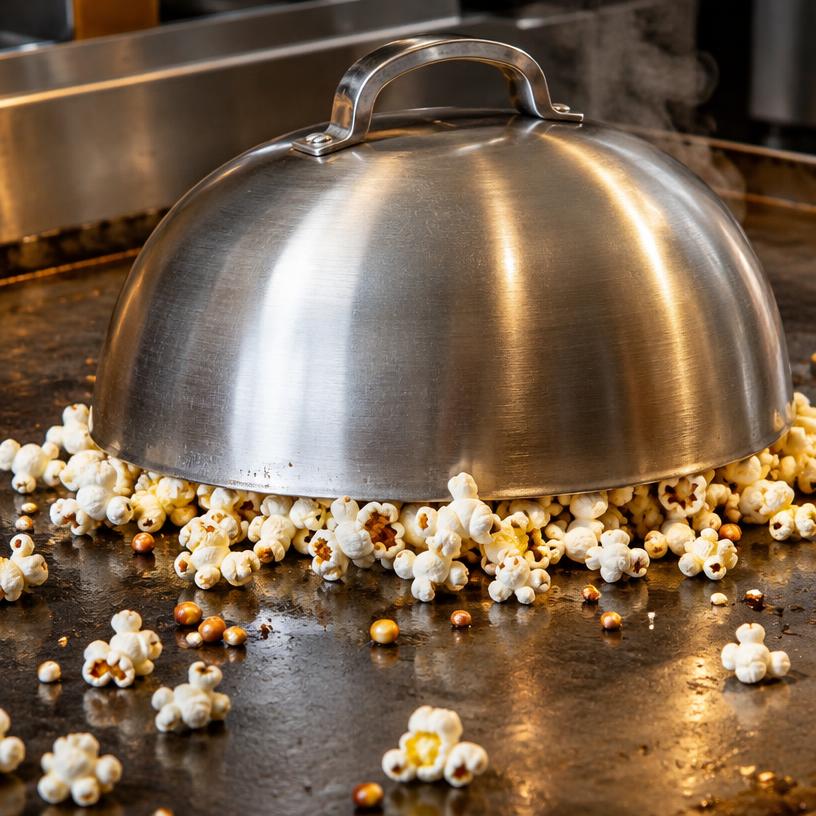
Dome popcorn
Zone 3 • medium
Works well with: Plain popcorn kernels, a teaspoon of oil, herbs or nutritional yeast
Squeeze 1–2 teaspoons of oil in a circle on Zone 3 and add 3 test kernels. Cover with the largest dome.
When the test kernels pop, add ¼ cup kernels in the oil and cover again.
Pop 2–3 minutes; lift the dome slightly to let steam out when popping slows to 2 seconds between pops.
Scoop into a bowl and season with smoked paprika, garlic powder, cinnamon or nutritional yeast instead of butter and salt.
Most kernels popped and none scorched. Whole-grain popcorn is a heart-friendly, high-fiber snack when you skip the butter.
More great griddle foods
French toast (whole-grain)
Zone 3
Egg-white and cinnamon batter, 2–3 minutes a side.
Quesadillas
Zone 3
Lightly oiled tortilla, beans, veggies, a little cheese; dome to melt.
Shrimp & vegetable hibachi
Zone 1–2
Zucchini and onion first, shrimp in the last 3 minutes.
Grilled cheese & sandwiches
Zone 3
Medium heat browns bread while the inside warms.
Chicken teriyaki
Zone 2
Brush homemade low-salt teriyaki only in the final minute.
Asparagus, mushrooms, broccolini
Zone 2
Splash water and dome 1 minute to steam, then sear.
Pineapple & peaches
Zone 2
2 minutes a side for caramelized dessert with no added sugar.
Tortillas & pita
Zone 4
20–30 seconds to warm and soften.
Part 06
Safety, care and fixes
Griddle and food safety
Use outdoors only, on a level, non-flammable surface away from the house, and never leave it unattended while lit.
Empty the grease cup after every cook — a full grease trap is the most common griddle fire.
Keep raw and cooked foods in separate zones and on separate pans; use separate spatulas or clean them between.
Cook to safe temperatures, checked with a food thermometer: poultry and ground turkey or chicken 165°F / 74°C, ground beef 160°F / 71°C, whole-cut steaks and chops 145°F / 63°C followed by a 3-minute rest, fish 145°F / 63°C until opaque and flaking, egg dishes 160°F / 71°C.
Turn off the burners, then the propane tank, when finished.